How we rate providers
Version 1.0 · July 2026 · reviewed monthly
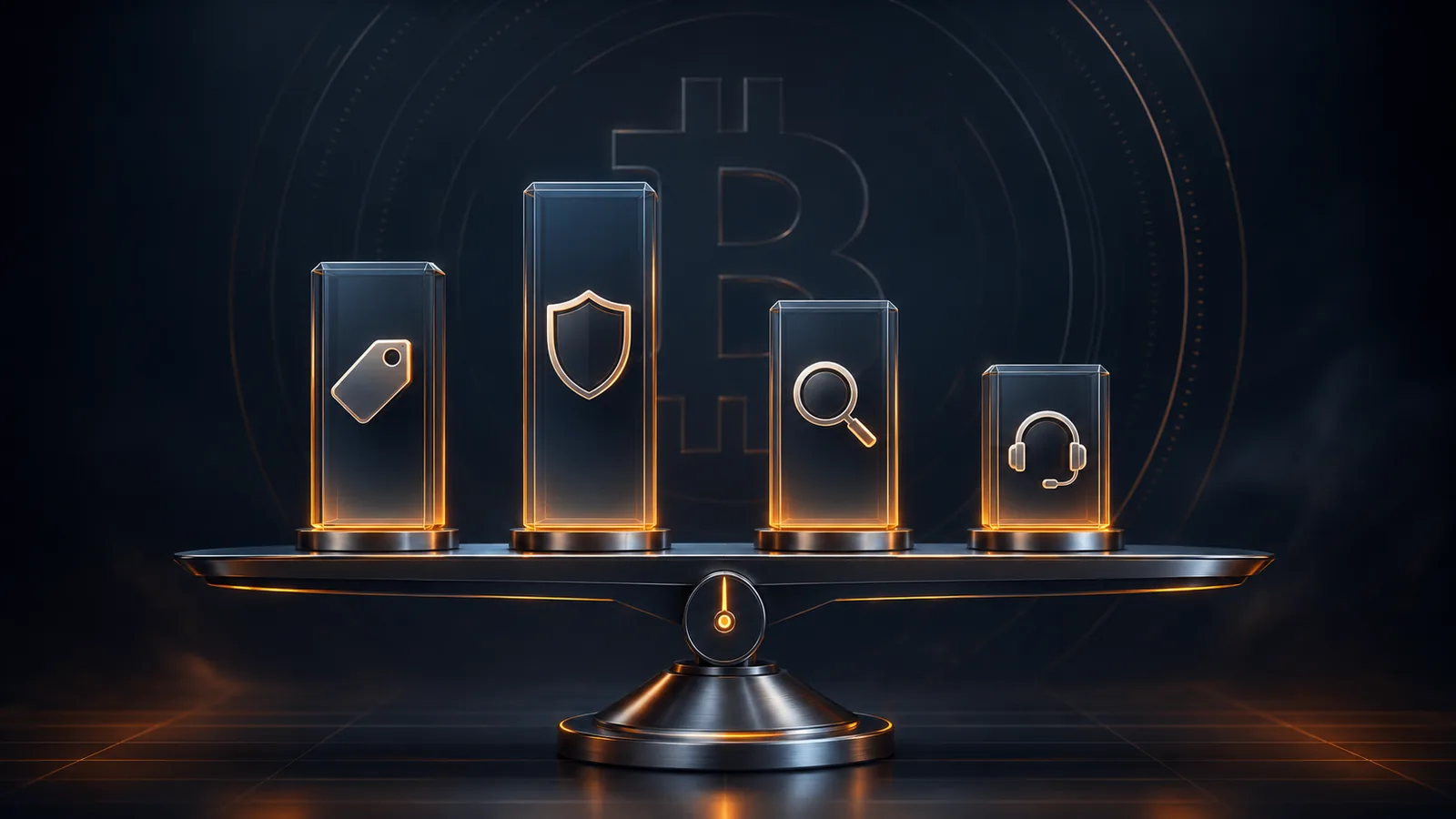
Every provider on CryptomineHQ is rated by the same four criteria with fixed weights. Affiliate partnerships never influence scores — the rubric below is applied identically to partners and non-partners. This page explains not just what we measure, but why each weight is set where it is, how we verify the underlying data and where that data comes from.
The four criteria at a glance
| Criterion | Weight | What we measure |
|---|---|---|
| Price | 30% | All-in kWh rate vs. market benchmark ($0.065–$0.08 in 2026), setup fees, hidden costs |
| Track record | 30% | Years in operation, incident history, verifiable payouts, halving cycles survived |
| Transparency | 20% | Public facility locations, status pages, company registry, named leadership, real photos |
| Support | 20% | Response times, SLA terms, hardware replacement handling, community feedback |
Why price is weighted 30%
In hosted mining, electricity is the dominant recurring cost — it dwarfs hardware depreciation over a multi-year horizon. A difference of a single cent per kWh compounds into hundreds of dollars per machine across a contract, and it directly moves your break-even point. That is why price gets the joint-largest weight. But we score the all-in rate, not the headline number: setup fees, maintenance surcharges, currency conversion spreads and minimum-consumption clauses are all folded in. A "cheap" $0.05/kWh quote that hides a fat setup fee scores worse than an honest $0.07/kWh all-in rate. We benchmark every rate against the 2026 market band of roughly $0.065–$0.08/kWh so the score reflects real competitiveness, not marketing.
Why track record is also weighted 30%
The cheapest provider on paper is worthless if it takes your deposit and disappears. Mining is a trust-heavy, prepay-heavy business, and the graveyard of collapsed "cloud mining" operations is proof that longevity matters as much as price. We give track record the same 30% weight as price because a proven operator is the single strongest defence against total loss. We measure verifiable years in operation, whether the provider survived previous Bitcoin halvings (a genuine stress test of a mining business model), documented incident history, and evidence of real, consistent payouts rather than screenshots. New entrants are not banned, but they start with a lower track-record score until they build a public history.
Why transparency is weighted 20%
Transparency is how you tell a real operation from a rendered one. We reward providers that publish concrete, checkable facts: physical facility locations, a public status/uptime page, a verifiable company registration, named and traceable leadership, and genuine photos rather than stock imagery. It sits at 20% because transparency is strongly correlated with the two heavier criteria — operators willing to show their registry entry and their data-centre address tend to be the ones with a real track record and honest pricing. Opaqueness is a warning sign, not merely a missing feature.
Why support is weighted 20%
Hardware fails, hashprice swings, and contracts throw up edge cases. When something goes wrong, the quality of support decides whether you lose a day or a month of revenue. We assess realistic response times, the concrete terms of any uptime SLA (including what compensation actually applies), how hardware replacement and RMA are handled, and the weight of community feedback about real support experiences. Support rounds out the score at 20% — meaningful, but secondary to whether the provider is cheap and whether it will still exist next year.
How the four weights combine
Each criterion is scored on a normalised scale and multiplied by its weight, then summed into a single provider score. Because price and track record together account for 60%, a provider cannot buy a top rating with slick support and a pretty website alone — nor can a rock-bottom kWh price rescue an operator with no history and no transparency. The weighting is deliberately front-loaded toward the two things that most often decide whether a mining investment makes money or evaporates.
Data sources & verification
We treat provider marketing as a claim to be verified, not a fact. Our inputs, in order of trust:
- Live sign-up flows and published price lists — cross-checked against the actual checkout, not just the landing page, and re-checked monthly.
- Company registries and public filings — to confirm the operating entity actually exists and is who it claims to be.
- Trustpilot and community reports (Reddit, mining forums) — read for patterns of incidents, not one-off complaints.
- Direct provider inquiries — where pricing or terms are ambiguous, we ask, and we note when a provider declines to answer.
Every comparison page carries a visible "last updated" date reflecting our monthly cycle. When a price changes or an incident surfaces, the score is recalculated. Found something out of date? Tell us — corrections are welcome.
Affiliate disclosure
CryptomineHQ is financed through disclosed affiliate links. Scores are calculated before any partnership discussion, and no provider can pay for a better rating or a higher ranking. Providers we consider unsafe are not listed at all — regardless of commission offers. More on our independence is on the about page.
Frequently asked questions
Can a provider pay for a better rating?
No. The rubric is applied identically to everyone, scores are set before any partnership talk, and unsafe providers are excluded no matter what they offer.
Why is price weighted at only 30%?
Price is the single biggest lever, so it gets the joint-largest weight — but a cheap rate is meaningless if the operator disappears, which is why track record matches it at 30% and transparency plus support add 40% combined.
How is the data verified?
We cross-check price lists against live checkouts, confirm entities in public registries, read community reports for incident patterns, and ask providers directly when data is unclear — then re-verify monthly.
Related
- Hosting comparison 2026 — see the methodology applied across every tracked provider.
- Provider reviews — full datasheets with the four-criteria breakdown per provider.
- Mining scam check — the safety gate that comes before any rating.
- Profitability calculator — plug in the verified kWh rates and run your own break-even.